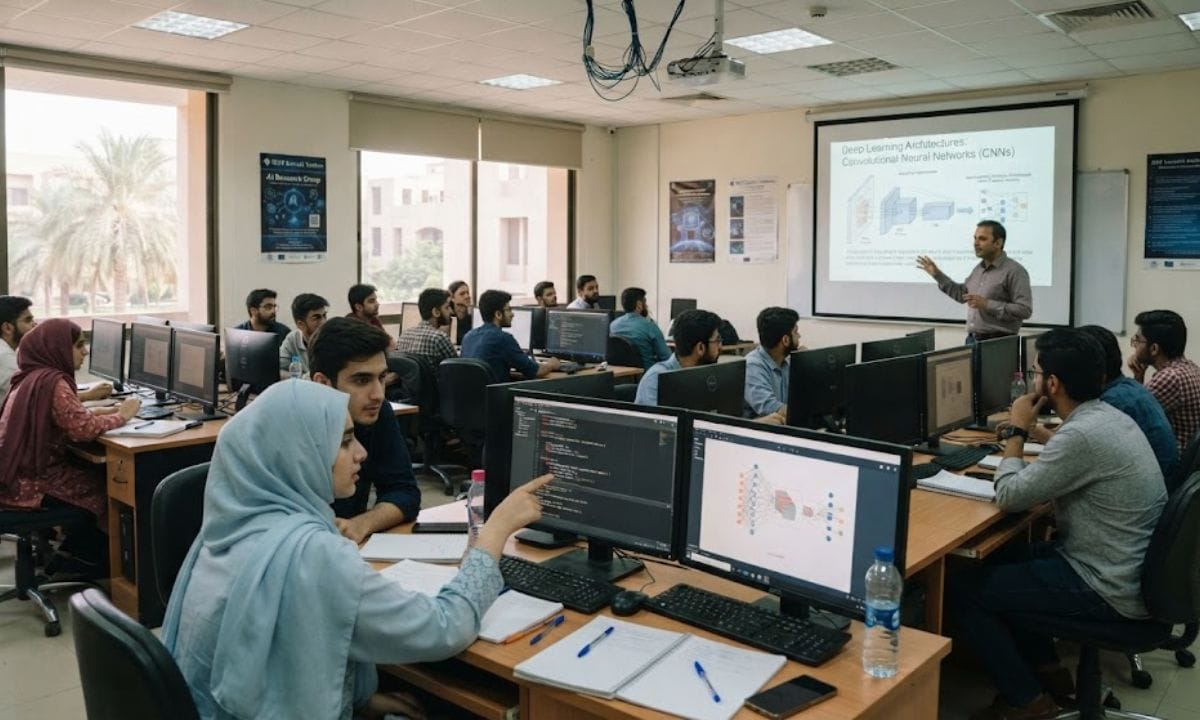
In a decisive move to modernise its curriculum, the academic council of Karachi University approved the introduction of an Artificial Intelligence programme that will span every faculty on campus. The decision was reached during a meeting held on Monday, with the council session presided over by acting Vice Chancellor Prof Muhammad Tufail Jokhio at the Chinese Teachers Memorial Auditorium.
The council’s endorsement marks a significant step for Pakistan’s higher‑education sector, signalling a broader commitment to embedding cutting‑edge technology studies within traditional academic structures. While the announcement was brief, it underscores the university’s intent to provide students across disciplines—whether engineering, business, or humanities—with foundational knowledge in AI, a field that is increasingly shaping global economies.
Key participants in the session included departmental chairpersons and directors of research centres, all of whom voiced support for the initiative. Their presence highlighted the collaborative nature of the proposal, suggesting that faculty leaders are prepared to integrate AI concepts into existing programmes and to develop new courses tailored to their respective fields.
Prof Jokhio, who has overseen the council’s deliberations, emphasized the importance of staying abreast of technological trends. He noted that the university’s leadership is committed to ensuring that graduates are equipped with the skills needed to thrive in a data‑driven world. The decision to roll out AI studies across all faculties reflects a recognition that artificial intelligence intersects with a wide array of academic pursuits—from algorithmic analysis in mathematics to predictive modelling in economics.
The announcement follows a growing national dialogue about the role of artificial intelligence in Pakistan’s development agenda. While the council’s minutes do not detail specific course structures or credit allocations, the approval lays the groundwork for future curriculum development. University officials anticipate that the new programme will attract both local and international students interested in AI research and application.
Experts in the field have long argued that embedding AI education across diverse disciplines can accelerate interdisciplinary research and innovation. By offering AI modules to students in non‑technical programmes, Karachi University aims to foster a generation of scholars who can apply machine learning techniques to solve complex problems in areas such as public policy, healthcare, and environmental science.
The university’s move also aligns with national efforts to strengthen Pakistan’s digital infrastructure. As the country seeks to boost its technology sector, educational institutions are pivotal in supplying a skilled workforce capable of driving AI‑driven initiatives. The new programme is expected to complement existing research centres and industry partnerships, creating a robust ecosystem for AI exploration.
While the council’s resolution sets the stage, the practical implementation will require careful planning. Faculty members will need to develop curricula, secure necessary resources, and possibly undergo training to deliver AI content effectively. The university’s administration has indicated that it will allocate support to ensure a smooth rollout, including the procurement of relevant software and hardware tools.
Students and alumni have expressed enthusiasm about the prospect of AI courses. Many anticipate that the expanded curriculum will open doors to research opportunities and enhance employability in a market where AI expertise is increasingly in demand.
In summary, Karachi University’s decision to institute an Artificial Intelligence programme across all faculties represents a forward‑looking investment in Pakistan’s educational future. By integrating AI into the academic fabric, the university is positioning itself as a leader in technology education and setting a precedent for other institutions nationwide to follow.